
ATIX AG
  • Services
    • Consulting
      • Linux Platform Operations​
      • Infrastructure Automation
      • Container Platforms and Cloud
      • DevOps Processes, Tooling and Culture
      • Cloud Native Software Development
    • Products
      • orcharhino
        • About orcharhino
        • Support
        • orcharhino operation
    • Technologies
      • Ansible
      • AWX and Ansible Automation Platform
      • Docker
      • Foreman
      • GitLab
      • Istio
      • Kubernetes
      • Linux Distributions
      • OpenShift
      • Puppet
      • OpenVox
      • Rancher
      • Rundeck
      • SaltStack
      • SUSE Manager
      • Terraform
  • Trainings
    • Ansible Training
    • AWX Training
    • Docker & Container Training
    • Git Training
    • Kubernetes Training
    • OpenShift Training
    • orcharhino Training
    • OpenVox/Puppet Trainings
    • Terraform Training
  • Events
    • Webinars
  • Blog
  • Company
    • About Us
    • References
    • Corporate values
    • Social engagement
    • Newsroom
    • Newsletter
    • Contact us
  • Career
  • German
  • Click to open the search input field Click to open the search input field Search
  • Menu Menu

SBOL: Open Source based exchange for biotech enthusiasts

Especially in the current time we experience how important the exchange between scientists is. Almost every day there are new findings that need to be discussed and debated.

ebook Infrastucture Automation

Free E-Book

Infrastructure Automation with Linux and Open Source Tools

This free e-book provides practical examples of how you can use Linux and open-source tools to simplify recurring tasks, reduce errors, and establish scalable IT processes.
Discover it now.

Download now for free

This applies to the situation in the current pandemic as well as to (biotechnological) research in general.

For example, the current state of research makes it possible not only to completely map – or, as it is called in technical jargon, “sequence” – the genome of bacteria and viruses, but also that of humans and animals. It goes even further: genes can not only be sequenced, but also completely synthesized and edited. Most people are probably familiar with the “Big Bang Theory” episode, in which a glowing goldfish is shown. In this illustration this is not scientifically correct, but it is possible: the fish do not glow themselves, but they fluoresce because the gene of a fluorescent jellyfish or sea anemone has been inserted. Thanks to this knowledge, suppliers like PetCo & Co. now have such a “GloFish” in their product range.

For example, in order to be able to exchange such findings with other biotechnology enthusiasts like these in a better and uncomplicated way, a group of scientists has joined forces and developed an international standard: The Synthetic Biology Open Language, abbreviated SBOL. SBOL is subtly divided into two parts:

On the one hand, there is the graphic part “SBOL Visual”: This describes which symbols are used for which functional components of DNA, RNA, etc. – short the “Central Dogma of Molecular Biology” plus X – are used. On the other hand, the data processing part is SBOL Data. This uses already existing principles from information technology such as the automatic conversion of base pair sequences into symbols.
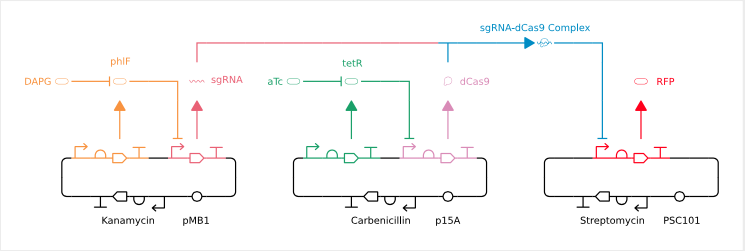
SBOL

Picture Description: Three DNA rings – also known as plasmids or mini-chromosomes – on which various genes and the interactions between them and their products are shown: A bent arrow (promoter), a semicircle (ribosome binding site), a full arrow (coding part) and a T (terminator) in each plasmid result in a gene. The black areas of the plasmids are responsible for organisational tasks such as self-preservation and reproduction of the plasmids in the living organism.
A red fluorescent protein – RFP – is produced from the gene marked in red. If the protein dCas9(pink) binds to a sgRNA(coral)(blue), the production of RFP is blocked because the connection makes the promoter inaccessible. From the green and orange marked gene proteins (phlF and tetR) are formed which in turn prevent the synthesis of dCas9 and sgRNA. With the addition of DAPG(orange) or aTc(green), these proteins can be manipulated so that they no longer inhibit the production of sgRNA and dCas9, which is ultimately a chemical on-off switch.

But what use is an “open language” if it is not easily accessible. Hardly any biologist, microbiologist or geneticist “speaks” Python, i.e. cannot easily work with the DNAplotlib library. So it had to be something simpler. And something simpler was delivered: Now researchers no longer have to learn a programming language to use the symbols professionally. Because an official font was added to the SBOL package.

We continue to work on SBOL and are constantly adding new symbols and functionalities based on new scientific findings. It is also planned to transfer the symbols to the Unicode table.

If you want to actively participate in development, you can do so in the official GitHub project. More information is also available on the official SBOL page or in this paper.

ATIX-Crew
+ postsBio

Der ATIX-Crew besteht aus Leuten, die in unterschiedlichen Bereichen tätig sind: Consulting, Development/Engineering, Support, Vertrieb und Marketing.


  • ATIX-Crew
    Foreman Birthday Party 2024
  • ATIX-Crew
    CrewDay 2024
  • ATIX-Crew
    Navigating the XZ Security Vulnerability: A Comprehensive Guide
  • ATIX-Crew
    Automating Kafka with Ansible
  • ATIX-Crew
    Managing Large Debian Repositories with Pulp
  • ATIX-Crew
    Configuration Management across Different Networks with AWX
  • ATIX-Crew
    pulp_deb past, present, and future – tell us what pulp_deb development should focus on next
  • ATIX-Crew
    DevOps Culture “without Bullshit”
  • ATIX-Crew
    ATIX @ CfgMgmt Camp 2020
  • ATIX-Crew
    The Future of Ansible
  • ATIX-Crew
    A somewhat different OSAD
  • ATIX-Crew
    Save The Rhino
  • ATIX-Crew
    Ansible Collections – More clarity and easier sharing in Ansible
  • ATIX-Crew
    Test Ansible roles with Molecule
  • ATIX-Crew
    Workshops in the Cloud – What Ansible, Docker and the GitLab CI/CD offer for this
  • ATIX-Crew
    ATIX Crew on Tour: Geocaching and pasta salad by the water
  • ATIX-Crew
    ATIX’s Debian/Ubuntu Erratum Service is now open source!
  • ATIX-Crew
    The ATIX crew @ Config Management Camp 2019
  • ATIX-Crew
    From the starting block into the fire!
  • ATIX-Crew
    orcharhino-installer Plugin Selection
  • ATIX-Crew
    fpm – the fast track to the parcel
  • ATIX-Crew
    ATIX #CrewDay: Rhino learns to speak!
  • ATIX-Crew
    SaltStack: Salty alternative to the puppet player
  • ATIX-Crew
    Snapshots for everyone!
  • ATIX-Crew
    Configuration management with Ansible
  • ATIX-Crew
    Creation of Foreman RPM packages with Docker containers
  • ATIX-Crew
    Rancher: New containers for the (server) farm – quick and easy
  • ATIX-Crew
    Rancher: Conducting a container pack
  • ATIX-Crew
    Docker Swarm: A herd of containers
  • ATIX-Crew
    ATIX at the Chemnitz Linux Days 2017 – A story from the perspective of our learners
  • ATIX-Crew
    Software-defined storage
  • ATIX-Crew
    Docker containers – a lightweight alternative to virtualization
  • ATIX-Crew
    Selenium IDE – Automated testing of web applications with a browser
ISO 27001 Certified Download ISO 27001 Certificate
ISO 9001 Certified Download ISO 9001 Certificate
Newsletter
Never miss anything again. Sign up for the ATIX newsletter!
Sign up now
Blog
  • Blog Start Page
  • ATIX Insights
  • Cloud Native
  • Container Plattformen und Cloud
  • DevOps
  • Infrastructure Automation
  • Linux Platform Operations
  • orcharhino
Privacy & Legal

Privacy Policy

Imprint

Terms and Conditions

B2B

Twitter     Facebook    LinkedIn    Youtube     mastodon=

© Copyright – ATIX AG

Scroll to top Scroll to top Scroll to top