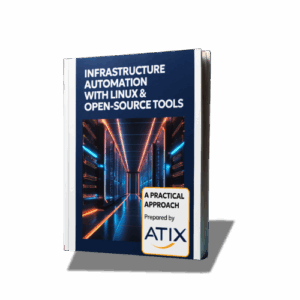
eBook: Infrastructure Automation with Linux and Open-Source Tools

Automate your IT infrastructure in a practical and sustainable way.
This eBook explains how provisioning, release and patch management, and configuration management can be automated across Linux environments. It covers typical implementation processes, the selection of suitable open-source tools, and real-world use cases from mature production infrastructures.

Infrastructure Automation with Linux: processes, tools & best practices

Automating IT infrastructure has become one of the most important success factors for organizations that need stable, secure, and scalable systems. This eBook shows how modern infrastructure automation works in practice—and how Linux and open-source tools enable a robust, future-ready IT operation.

Infrastructure automation helps reduce repetitive work, lower error rates, and provision new systems significantly faster. This eBook walks through how to structure provisioning, patch management, and configuration processes so IT teams can focus on higher-value tasks while systems remain stable and consistent.

What makes this eBook especially valuable

This eBook goes far beyond a theoretical introduction. It explains how infrastructure automation is applied in real, established IT environments, including common operational constraints, dependencies, and technical challenges.

Rather than focusing on individual tools or abstract concepts, the eBook demonstrates how automation can be introduced and expanded as a structured process. It addresses both technical and organizational aspects, including tool selection, documentation, implementation strategy, and working with existing systems.

A key focus is the practical automation of Linux-based infrastructures. Using real-world scenarios, the eBook illustrates how recurring tasks—such as provisioning, release and patch management, and configuration management—can be implemented consistently and at scale using open-source tools.

The eBook also highlights common challenges in automation projects, such as:

  • integrating existing systems into automated workflows
  • combining multiple tools within a unified automation strategy
  • expanding automation gradually without disrupting operations
  • building transparent, maintainable processes

Why Infrastructure Automation is essential today

As IT landscapes grow more complex, the need for automation increases. Even basic tasks such as updates or configuration changes become error-prone and difficult to manage without clear automation workflows.

The eBook explains how automation helps:

  • reduce downtime
  • minimize security risks through automated patching
  • deploy systems consistently and reproducibly
  • integrate open-source tools across heterogeneous environments
  • strengthen digital sovereignty and reduce vendor lock-in

How Infrastructure Automation Reduces Costs

Organizations that automate their infrastructure see long-term reductions in operating costs. The eBook details how automation helps:

  • lower manual work for routine tasks
  • reduce configuration errors
  • accelerate rollouts and make them predictable
  • maintain stable and fully reproducible systems
  • respond to security vulnerabilities faster

With rising IT costs and skilled labor shortages, infrastructure automation delivers a measurable advantage.

Key technologies explained

The eBook introduces the most important open-source tools for infrastructure automation, including:

  • tools for automated provisioning
  • configuration management solutions
  • patch and update automation systems
  • monitoring components that support automation
  • integrations for hybrid and heterogeneous environments

Each tool is described with strengths, typical use cases, and practical examples to help you choose the right technology for your infrastructure.

Practical examples from real IT environments

Through practical case studies, the eBook shows how companies have used infrastructure automation to:

  • drastically shorten deployment times
  • improve security and patching processes
  • increase visibility in complex system landscapes
  • strengthen digital sovereignty
  • reduce ongoing operational costs

These examples help you develop your own automation strategy while avoiding common pitfalls.

FAQ: Infrastructure automation in Linux infrastructures

Infrastructure automation describes the use of software for the automatic provisioning, configuration, updating, and management of IT systems. The goal is stable, secure, and reproducible operation.

Linux is flexible, stable, and open. Its large community and the multitude of available open source tools make it the ideal platform for efficient automation.

Open source offers transparency, independence, and full control over the IT stack. Companies can customize, expand, and operate solutions themselves in the long term.

Automation replaces manual tasks, reduces errors, and speeds up processes. This lowers personnel costs and operational risks.

Yes. The eBook shows how automated processes can be used both on-premises and in cloud and hybrid infrastructures.

ebook Infrastucture Automation